Payment Processing · Buyer guide
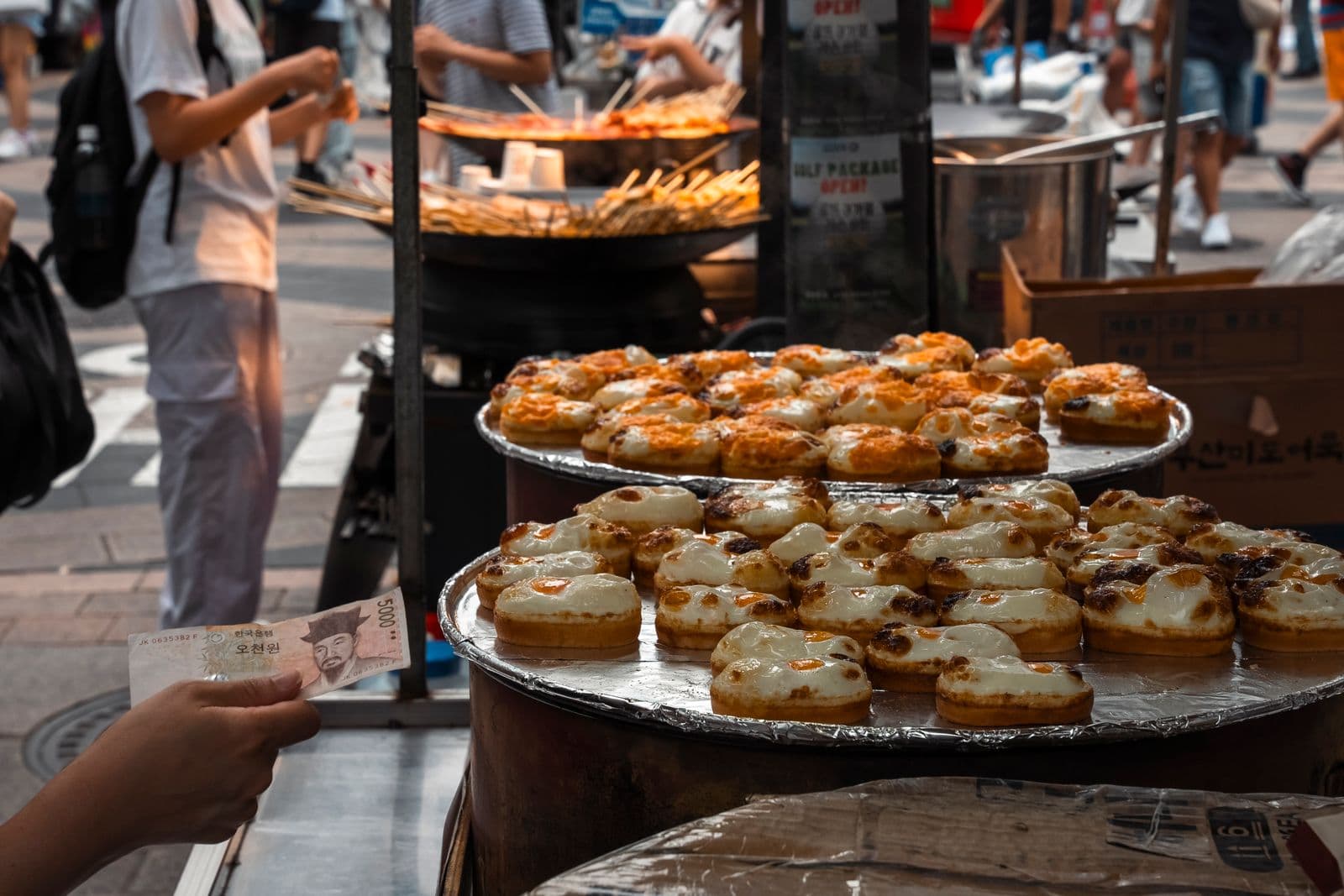
South Korea sets by regulation what most of its businesses pay to accept cards. In the round that took effect on 14 August 2026, the Financial Services Commission said 95.7% of credit card merchants, 3.094 million of 3.235 million, qualified for a preferential rate set by regulation. Card spending averaged ₩3.8 trillion a day in the first half of 2026, according to the Bank of Korea, and credit cards made up 79.7% of it.
The rest of this guide covers what those rates are, what the larger merchants outside them pay, what online payment gateways add, and the rules on refusing cards and surcharging. Figures were read from the Financial Services Commission's releases, the law, the card industry's disclosures and the providers' own pages on 31 October 2026.
Under the Specialized Credit Finance Business Act and its enforcement decree, a merchant with annual sales of ₩3 billion or less is a small or mid-size merchant, and the Financial Services Commission sets the most a card company may charge it. The current table, in force since 14 February 2025:
Each figure was cut by 0.05 to 0.10 points in February 2025: the smallest band paid 0.50% on credit and 0.25% on check cards before. The commission estimated the cut at about ₩300 billion a year for merchants. Sales of every outlet owned by the same person or company are added together to decide the band.
The rates are based on what the commission calls the card companies' qualifying costs, and it decided in December 2024 to recalculate them every six years in principle rather than every three. It will still check every three years whether a recalculation is needed, in the first half of the year, and recalculate in the second half if it is. On that timetable the next check would fall in the first half of 2027.
Card companies reclassify merchants twice a year from National Tax Service data, and the new rates apply from 14 February and 14 August. From May 2026 sales are the only test: an earlier separate route for simplified VAT taxpayers was removed, although the commission says merchants with sales under ₩300 million still qualify as before.
A new business pays the general rate until its sales can be confirmed, then gets the difference back. In the round due to be paid by 28 September 2026, card companies were to refund about ₩61.47 billion to 159,000 merchants that opened in the first half of 2026, about ₩387,000 each. The commission's own example: a merchant with ₩140 million of card sales, charged 2.2% and entitled to 0.4%, gets ₩2.52 million back. Merchants can check their status at cardsales.or.kr, run by the Credit Finance Association.
Above ₩3 billion of annual sales, a merchant negotiates with each card company. No legal ceiling applies; the law requires rates based on the card companies' costs that are fair and reasonable. The card industry must publish its averages, and for 2025 they were 2.08% on credit cards, 1.44% on debit cards and 1.45% on prepaid cards across all general merchants. They barely vary with size: 2.10% on credit for merchants with ₩3 billion to ₩10 billion of sales, and 2.08% above ₩50 billion.
When the commission cut the preferential rates in December 2024, the card companies also agreed not to raise the rates of general merchants with annual sales of ₩100 billion or less for three years, even where their costs rose. The law also works in the other direction: a merchant with sales above ₩300 million may not demand an unfairly low rate from a card company, on pain of up to a year in prison or a ₩10 million fine, or demand or take a kickback, on pain of up to five years or ₩30 million.
Take a café with ₩250 million a year of sales, all on credit cards. At the 0.40% preferential rate it pays ₩1 million a year in card fees. At the 2.08% general average it would pay ₩5.2 million. An individual business with sales of ₩1 billion or less can also deduct 1.3% of its card and cash-receipt sales from its VAT bill, up to ₩10 million a year, through 2026, which here is worth about ₩3.25 million. The government has proposed extending the credit to 2029 but at 1.2% with a ₩5 million cap from 2027, which would make it worth ₩3 million here; the National Assembly has not yet decided. That is why the commission says that, up to ₩1 billion of sales, the tax credit usually exceeds the card fees paid.
An online shop usually signs with a payment gateway, which holds the card company contracts. The gateway charges its own published rate, and Korean gateways quote prices before 10% VAT.
Gateway sub-merchants are covered by the preferential system. The supervisory regulation treats an online seller registered for VAT with sales of ₩3 billion or less as a small or mid-size merchant for those transactions, and in the August 2026 round 92.0% of gateway sub-merchants qualified. Refunds for them go through the gateway: 132,000 sub-merchants were refunded in the September 2026 round. The gateway's own margin still applies, so ask what you will actually pay in your sales band, not only the general rate.
The big payment wallets disclose what they charge merchants twice a year. For September 2025 to February 2026, the 18 firms in the disclosure charged a weighted average of 1.98% on card payments, according to the Financial Supervisory Service. Kakao Pay's own disclosure for that period shows 0.38% on card payments for the smallest merchants and 1.62% for general merchants; Toss Pay's shows 0.79% and 2.01%. Both exclude VAT.
For a card machine in a shop, the fee to the card company already includes the VAN companies that route the transaction, which have been paid a percentage of each sale rather than a flat fee per transaction since 2018. Terminal prices are usually set by dealers and are rarely published.
Article 19 of the Specialized Credit Finance Business Act says a merchant may not refuse a card payment or treat a cardholder unfavourably because they pay by card, and may not make the cardholder bear the merchant fee. Each breach carries up to a year in prison or a fine of up to ₩10 million, and card companies must terminate the merchant's contract after a conviction for surcharging, or on written notice from a tax office of either breach. So the cost of cards goes into your prices, and for most merchants, with the preferential rates and the VAT credit, it is small.
Korea is not a country where you can open a Stripe account, but Stripe lets merchants elsewhere accept Korean cards, Kakao Pay, Naver Pay, Samsung Pay and PAYCO without a Korean entity, through a local processor. For a US account it charges 3.1% plus 30 cents, plus 1.5% for an international transaction and 1% if currency conversion is needed, and pays out after four days in the US or seven elsewhere. KOMOJU charges 4.5% on Korean cards and on Naver Pay and PAYCO, and 2.95% on Kakao Pay, with no sign-up or monthly fee. Adyen's published price list, in US dollars, shows Korean cards at $0.13 plus 3.60% and Kakao Pay at $0.13 plus 3.3%.
For a Korean business selling abroad, PayPal's Korean fee page charges 4.40% plus a fixed fee to receive a payment from another country, with 3.00% for currency conversion in most cases. Toss Payments also sells PayPal acceptance to its merchants, at 4.0% plus US$0.30 plus a 2.5% conversion and withdrawal fee, before VAT.
Toss Payments is due to merge into its parent, Viva Republica, the company behind the Toss app. A correction Viva Republica filed on 28 October 2026 moved the merger date from 30 November 2026 to 31 March 2027, and changed only the timetable. For the region, see our guides to card fees in Japan, Hong Kong and Singapore.