Payment Processing · Buyer guide
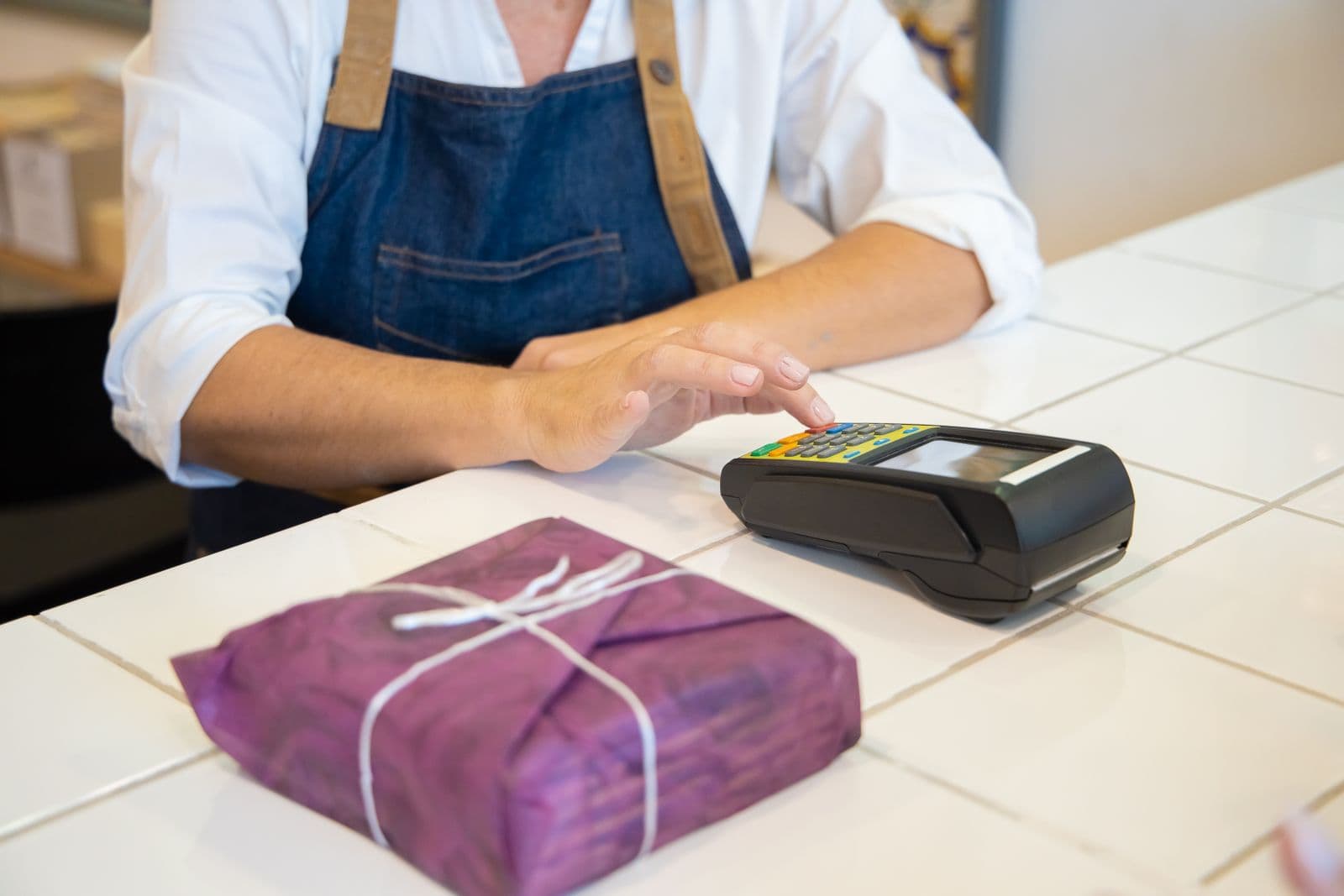
When a customer in a South African shop taps a local debit card, the bank that issued the card earns 0.44% of the sale in interchange. On a local credit card it earns 1.48%. Those are not market prices. The South African Reserve Bank sets them. Both took effect on 17 March 2015, and they are still the rates in the Reserve Bank's table, last updated on 5 February 2026.
The shop pays something else. It pays whatever its card machine provider charges, and on the published small-business rates that runs from 1.80% at FNB to 2.75% at iKhokha, before VAT, the machine or the payout. This guide sets out what each provider publishes, read from its own pages on 7 October 2026, puts them on one basis, and explains the two rules that shape the market: regulated interchange and the ban on surcharges.
The Reserve Bank took on interchange after the Competition Commission's Banking Enquiry recommended it in 2008. Its rates cover the fee the card issuer earns, and nothing else. For card purchases where both sides support the security standard, they are, excluding VAT:
Different rates apply when only one side supports chip or 3D Secure. When only the card issuer does, the rate is higher: an online credit card purchase where only the issuer supports 3D Secure carries 2.45%, effective 21 September 2020, the last time any card rate in the table changed. When only the merchant's bank does, it is lower: 0.36% on debit and 1.41% on credit in person.
The rates are due for review. In October 2024 the Reserve Bank announced Phase V of its Interchange Determination Project, which started on 27 August 2024 with Deloitte, was expected to take 24 months, and is to review the methodology and rates for the regulated payment streams and determine rates for additional ones. The 24 months ran out in August 2026; as of 7 October 2026 we found no published outcome, and the Reserve Bank still lists the February 2026 table as current.
Nothing regulates the price a provider charges a merchant. That price is interchange plus the card scheme's fees plus the provider's costs and margin. On a debit card the regulated part is under half a percent, so most of a small shop's card bill is the provider's price, which is the part worth shopping on.
Transaction rates below exclude VAT, which is how these providers quote them; Absa's brochure does not make clear whether its percentage includes VAT. Machine prices and monthly fees are as printed; we note where a provider says whether VAT is included.
QR-code apps sit alongside these. SnapScan charges 2.95% excluding VAT, falling with turnover, with no monthly fee or hardware, and Zapper 2.9% on its free plan. Neither is reviewed on this site.
Take a café taking R35,000 a month on cards: 350 sales averaging R100, all local cards, all in person. That is R420,000 a year, inside FNB's lowest band and below the R50,000 a month at which Yoco's and Capitec's debit discounts begin. Transaction fees, before VAT:
Now take a busier shop at R70,000 a month, 60% of it on debit cards. Yoco's and Capitec's debit discounts now apply, and on FNB's pricing guide the merchant moves into its R500,000 to R6 million band. Yoco Core comes to about R1,211 (1.35% on debit, 2.30% on credit). Capitec comes to R875 (0.85% and 1.85%). FNB comes to about R861 for an FNB-banked merchant (0.85% and 1.80%) on its guide's bands, or R1,260 at the website's flat 1.8%. Payfast's flat 2.5% comes to R1,750, and iKhokha's 2.55% band to R1,785.
Two things fall out of that arithmetic. The first is that debit cards are where the big gap sits. Interchange on a debit tap is 0.44% against 1.48% on credit, yet Payfast and iKhokha charge one rate for every local card, and so do Yoco's Core plan and Capitec below R50,000 a month and FNB's lowest band. A small shop whose customers mostly pay by debit is paying credit-card prices on them. The debit discount only appears where a provider prices debit separately, which on these price lists means higher volumes.
The second is that Yoco's paid plans do not pay for themselves on rate alone. Above R50,000 a month, Plus saves 0.10 of a point on every local card and costs R249 a month including VAT, about R217 before VAT, so it breaks even at roughly R217,000 a month of card sales, which is past the R200,000 at which Yoco offers custom rates anyway. Its features may be worth the fee; the rate cut is not the reason to buy it.
Online, the reviewed providers are closer together. On a R500 local card sale, before VAT:
Pay-by-bank is cheaper. Peach charges 1.50% + R1.50 for Pay by Bank and Capitec Pay, R9.00 on R500. Paystack charges 2% with no flat fee for Capitec Pay and Ozow EFT, R10.00. Payfast lists Instant EFT and Capitec Pay at 2% with a R2 minimum, but its worked example and its calculator both charge 2% plus R2, R12.00 on R500. Flutterwave's EFT rate is 2.5%.
Foreign cards usually cost more online: Paystack charges 3.1% + R1, Peach and Yoco 3.50% plus their fixed fee, and Flutterwave 4.8%. Payfast is the exception; its fee table has no separate international rate.
PayPal (A-) is a different tool: a South African account receives money online at 3.40% plus a fixed fee on domestic payments and 4.40% plus a fixed fee on international ones, the fixed fee set by the currency received, and withdrawing to a local bank goes through a third-party provider at 2.0% + US$1.50 plus that provider's own fees. It is not a card machine or a local checkout.
Every transaction rate above excludes VAT, and providers add 15% VAT to their fees. Yoco's own example: on a R100 sale at 2.30%, the fee is R2.30, VAT on it is R0.35, and R97.35 reaches your account. A VAT-registered business can claim that VAT back from SARS; one that is not registered cannot, so its real rate is 15% higher than the quote: 2.30% becomes 2.645%. Many small shops are in that position, since the compulsory registration threshold rose from R1 million to R2.3 million of taxable turnover on 1 April 2026. Check, too, whether monthly fees are quoted with or without VAT. Yoco's subscriptions include it; FNB's rental and Standard Bank's monthly fees are printed without it.
In the United States, a business can often add a card surcharge. In South Africa the payment system's rules forbid it. The Payments Association of South Africa, which makes the rules for the banks and payment firms in the national payment system, restated in June 2025 that its rules do not allow merchants to charge extra for purchases made with a card, and that the acquirer, the bank or payment firm that signed up the merchant, must enforce that through its merchant agreements. A customer who is surcharged is told to report it to their own bank, which takes it up with the merchant's acquirer. The card bill comes out of the margin, which makes the choice of provider the main lever there is.
Free payouts are standard but not universal, and speed varies. Yoco's standard payout is free and reaches your bank two to three business days after the sale: it pays out the day after, and banks take one to two days more. An instant payout on its Core plan costs 1.50% plus VAT, with a minimum of R15 to R17.25 including VAT on requests under R1,000 (its help centre and product page give different figures). FNB pays FNB-banked merchants next day and others in two to three days. Capitec pays next day, weekends included. iKhokha pays next business day into FNB and Absa accounts and twice a day, same day, into Nedbank accounts and its own debit card. Payfast charges R8.70 per payout on its online accounts and 0.8% (minimum R14) for an immediate one. Our guide to instant payout fees shows how quickly a percentage fee for speed adds up when you use it every day.
Once you are trading, check each month's fees against the quote. Our guide to reading a merchant processing statement is written for US statements, but the lines are the same: a rate, fixed fees and monthly charges. For how another regulated market compares, see our guide to UK card machine fees, where interchange is capped by law rather than set by a central bank.