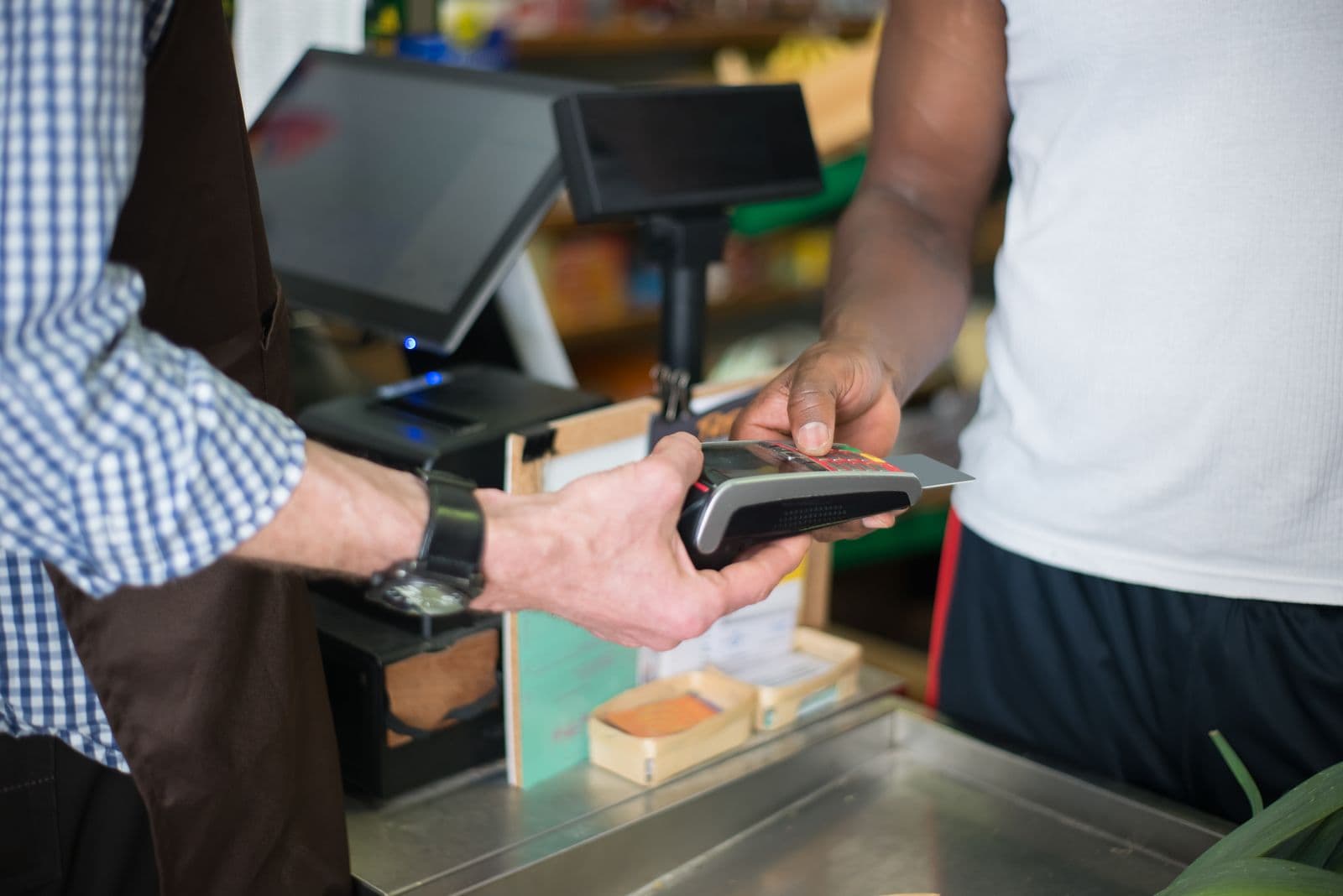
When a customer in an Irish shop pays with an Irish personal debit card, the bank that issued the card can charge the shop's provider no more than 0.2% of the sale in interchange. On a personal credit card the cap is 0.3%. Both limits come from the EU Interchange Fee Regulation, which has applied since December 2015. They do not cover company cards or American Express.
The shop pays neither figure. It pays whatever its card machine provider charges, and among the providers this site has reviewed that runs from 0.8% plus 2 cents at Revolut to 1.75% plus VAT at Square, about 2.15%, before the machine, the monthly fee or the contract. Here is what each provider publishes, read from its own pages on 20 October 2026 (its Irish page wherever it has one). Hardware prices exclude VAT unless stated.
The providers that publish a rate
- Revolut Business (our grade: B): 0.8% + €0.02 in person on domestic and European consumer cards, 1% + €0.20 online. Commercial and non-European cards are 2.6% + €0.02 in person. Card acceptance comes with a Revolut Business account, from €10 a month on the Basic plan, and the Revolut Terminal is €189, the Lite Terminal €139. Tap to Pay on iPhone adds €0.08 a sale.
- SumUp (B+): 1.69% in person with no monthly fee, on every card including American Express. Its Payments Plus plan at €19 a month, which SumUp's other plans suggest is before VAT, cuts domestic consumer cards to 0.95% according to the plan card and the reader FAQ, and to 0.99% according to the fee table on the same pricing page; premium, international and Amex cards stay at 1.69%. Readers cost €25 to €135 and there is no long-term commitment.
- Mollie (B+): 1.20% in person on domestic consumer cards with no monthly fee, or 0.85% + €0.10 on its Pro plan at €20 a month. Other consumer cards are 1.80%, Amex 2.10% and commercial cards 2.90%. Mollie's pricing page is a single EU page rather than an Irish one, and its help centre lists the tap-to-pay apps as available in Ireland and its card terminals as on request. The Tap terminal is €95 and the full terminals €350; pay-as-you-go allows one terminal and not the PAX models.
- myPOS (B): 1.59% + €0.05 on European consumer cards in person for businesses under €10,000 a month, with no monthly fee. Amex is 2.45% + €0.05 and every other card, commercial cards included, 2.89% + €0.05. Devices are bought outright from €39.
- Viva.com (B): 1.69% on European consumer cards in person, with a minimum fee of €0.03, and 2.19% + €0.24 online. Commercial, UK and non-European cards are interchange plus scheme fees plus 1.16%, and Amex is 2.75%.
- Stripe (A): 1.4% + €0.10 in person on European cards through Stripe Terminal, 2.9% + €0.10 on cards from elsewhere; 1.5% + €0.25 online on standard European cards. Readers run from €59 to €289. There is no monthly fee for processing, though readers with cellular data cost €9 a month each.
- Square (A): 1.75% plus VAT in person on EU and EEA cards, with 1.5 points more on UK and other non-EEA cards; 1.4% + 25c plus VAT online. The reader lists at €19 and the Terminal at €169, both discounted by 30% when we looked. Square quotes its processing fee plus VAT, as does Shopify; at Ireland's 23% standard rate that takes Square's 1.75% to about 2.15%.
The ones that quote, rent, or bundle
- Elavon (C-), the merchant business of U.S. Bank in Ireland, rents terminals from €17 a month with a transaction fee "from 0.99%" on its entry plan, and from 1.2% on its €50-a-month register plan, which also needs a POS software licence at €10 to €40 a month. It does not publish the contract length or any minimum charge, so the 0.99% is a floor, not a quote.
- BOI Payment Acceptance is sold through a marketing alliance with Bank of Ireland but run by Global Payments, whose Irish branch the page says is not part of the Bank of Ireland Group. It sells fixed monthly plans; the one it prices publicly covers €4,000 of card spend for €60 a month including the terminal, which is 1.5% if you use all of it. Above €8,000 a month it offers bespoke pricing. Businesses new to card payments can try its terminals for five months and end the contract without penalty, subject to its terms.
- AIB Merchant Services, which sells Clover in Ireland, and Worldline publish no Irish small-business prices at all. Both have to be asked.
- Dojo (B) blocked every attempt to read its site on 20 October 2026. An archived copy of its Irish pricing page from June 2025 showed 1.4% + 5c on consumer cards in person, a €20 monthly terminal fee, a six-month contract that then rolls monthly, and a €24.95 minimum monthly charge. Those figures are more than a year old; ask for the current ones in writing.
- Shopify Payments (A-) charges 1.7% in person and 2% + €0.25 online on its Basic plan, which is €24 a month billed yearly or €32 monthly. Its Irish pricing page states all of these excluding VAT.
What a small shop actually pays
Take a café taking €8,000 a month on cards: 400 sales at an average of €20, all on Irish personal cards tapped in person. That is close to the real Irish pattern; the Banking & Payments Federation Ireland reports that 89.9% of card payments in shops in the first half of 2026 were contactless, and that the average contactless card payment was €15.36. On the published rates, a month comes to:
- Revolut Business: €72 in fees plus the €10 Basic plan, €82
- SumUp Payments Plus: €95 at 0.95% including the €19 plan, or €98.20 at the fee table's 0.99%; about €99 to €103 if VAT is added to the plan fee
- Mollie pay-as-you-go: €96
- Elavon: €96.20 at its lowest advertised rate and rental, which is a floor rather than a quote
- Mollie Pro: €128 including the €20 plan, because the 10-cent fixed fee costs €40 a month at this ticket size
- SumUp pay-as-you-go and Viva.com: €135.20 each
- myPOS: €147.20
- Stripe: €152
- Square: €140 plus VAT, about €172.20
Two things move that order. The first is the fixed fee. At a €20 ticket, Stripe's 10 cents adds half a point to every sale and myPOS's 5 cents a quarter of a point, while SumUp, Viva.com and Square charge none. A shop with €80 average sales would see Stripe and myPOS climb the list. The second is the card mix. Every cheap rate above applies to consumer cards issued in Ireland or Europe. Commercial cards cost 2.6% at Revolut and 2.89% at myPOS, and tourists' non-European cards cost more almost everywhere, so a hotel bar and a suburban café can rank the same providers in different orders. The site's guide to dynamic currency conversion explains the offer a terminal may make to those tourists, and who earns from it.
Plans pay off at different volumes. SumUp's €19 plan saves 0.74 points on domestic consumer cards, so it covers its cost at about €2,600 a month of such cards, or about €3,200 if VAT is added to the fee; SumUp's own page puts the break-even at €3,300. Mollie's Pro plan has a higher bar, because its 0.35-point saving has to cover both the €20 fee and 10 cents a sale: no sale under about €29 ever comes out ahead, and at €8,000 a month the average sale has to be around €100 before Pro is cheaper.
You cannot pass the fee on
Since 13 January 2018 Irish law has banned surcharges on any card whose interchange is capped, which means personal debit and credit cards. The rule is Regulation 86 of the European Union (Payment Services) Regulations 2018. A business may add a fee for a company card, but it may not exceed the business's direct cost of accepting it. For a shop serving the public, the card fee comes out of the margin, which makes the choice of provider the only lever there is.
Two other rules are often mistaken for merchant costs. Irish stamp duty on cards is paid by the cardholder, not the shop: 12 cents per ATM withdrawal, capped at €2.50 or €5 a year, and €30 a year on a credit card account. And the Finance (Provision of Access to Cash Infrastructure) Act 2025, which commenced in June 2025 with its bank obligations in effect since 28 November 2025, puts its duties on AIB, Bank of Ireland and PTSB, not on retailers. A proposal to require supermarkets and pharmacies to accept cash has not become law.
Account-to-account payments are not a shortcut yet
Since October 2025 every euro-area bank has had to send instant transfers, with a free check that the payee's name matches the account, under the EU Instant Payments Regulation. That has not yet produced a cheap way for an Irish shop to take a payment at the till. Zippay, the app AIB, Bank of Ireland and PTSB launched in March 2026, sends money between people by mobile number and has no merchant checkout. The options that exist are run by payment firms and only work for their own users. Revolut Pay costs a Revolut merchant 0.5% + €0.02 in person, 0.3 points below its card rate, but only when the customer pays from a Revolut account. PayPal charges 0.90% + €0.10 for a QR code payment over €10, which is more than the cheapest card rates above.
What to ask before you sign
- Get the rate for each card type, not one headline figure: Irish consumer debit and credit, other European, commercial, American Express and non-European. The interchange cap only covers consumer cards.
- Ask whether VAT is added to the processing fee. Square's Irish pricing says it is.
- Ask for every fixed charge: per-transaction cents, refund fees, minimum monthly charges and terminal rental.
- Ask how long the contract runs and what leaving early costs. A rented terminal cannot be walked away from until the term ends; a reader bought outright can.
- Ask when the money arrives and where. Several of the cheapest providers settle fastest into their own business account, and more slowly to an Irish bank.
We found no Irish equivalent of the UK rule that caps the initial term of a card terminal contract at 18 months for merchants with up to £10 million of card turnover; the site's UK card machine fees guide explains how that works. Once you are trading, check your statement against what you were quoted. The site's guide to reading a merchant processing statement is written for US statements, but the lines are the same: a rate, a set of fixed fees and a monthly charge, and the fixed fees are where prices usually drift.