Industry · Payment Processing
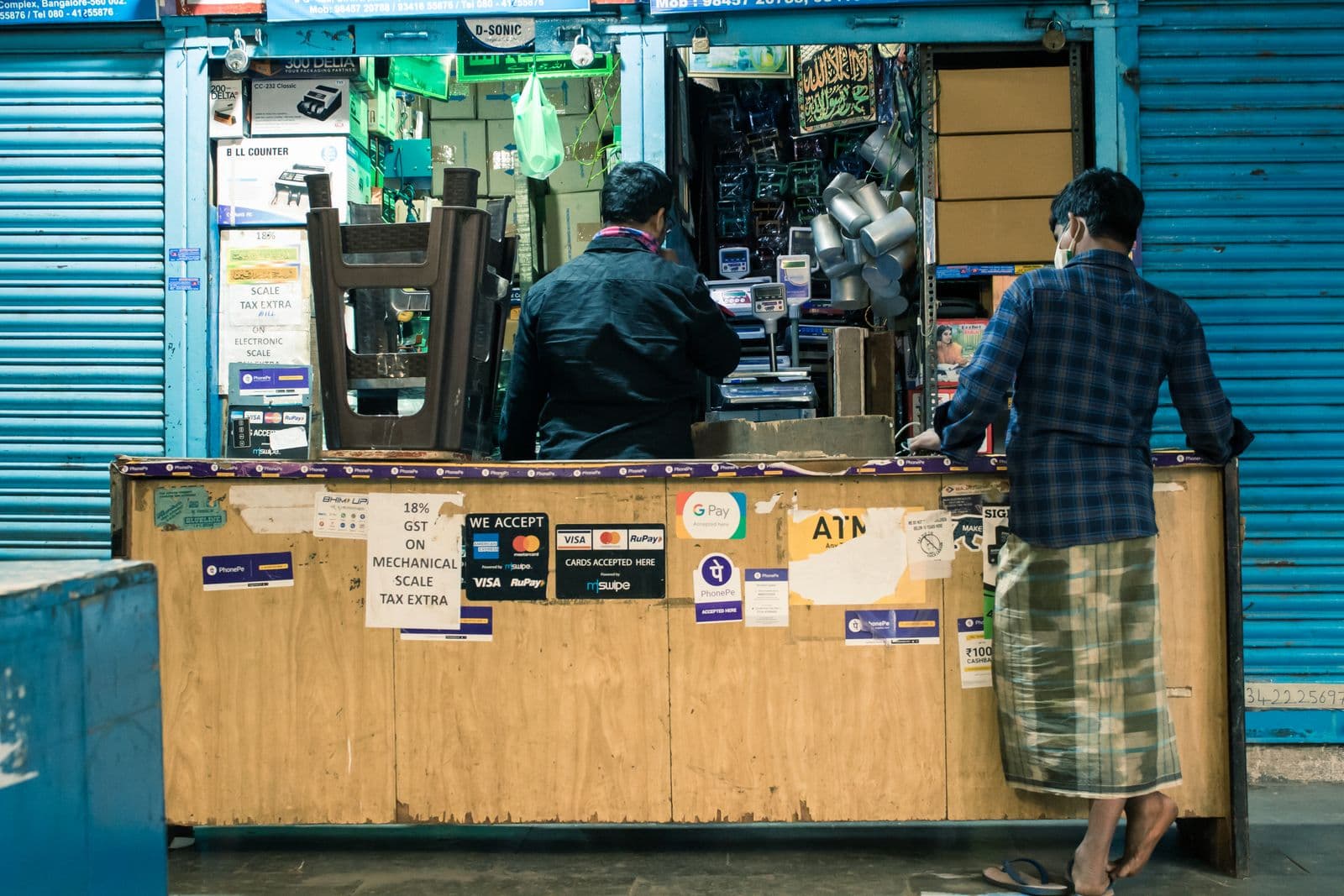
Since January 2020 an Indian business has paid nothing to its bank for a customer's UPI payment. That ends on 15 October 2026. From that date a person-to-merchant UPI payment above ₹2,000 carries a merchant discount rate (MDR) of 0.4%, capped at ₹300 on payments of ₹75,000 and above. Payments of ₹2,000 or less stay free, and so do the smallest merchants. The customer pays nothing either way.
The figures below come from the frequently asked questions the Department of Financial Services published on 15 September 2026, which is the most detailed official statement of the framework. It is not a small change in scale: the same document says UPI processed 2,451 crore transactions worth ₹29.9 lakh crore in August 2026. But how much it changes your costs depends almost entirely on how you take UPI today. A shop with a bank QR code is going from zero to 0.4%. An online seller paying a payment gateway was never at zero in the first place.
Two rules protect the customer. Merchants may not pass the MDR on to the buyer, and UPI apps may not charge a platform fee on any UPI payment. For a business, that means the 0.4% comes out of margin. The site's explainer on card surcharging covers the card-network rules in the United States; UPI now has its own no-surcharge rule, and it is stricter.
The main exemption is the P2PM category, short for person-to-person-merchant. These are small vendors who receive UPI payments directly into their own bank accounts, and those receiving up to ₹1 lakh a month through UPI QR pay no MDR on any payment, including one above ₹2,000. GST registration is not required to qualify. Acquiring banks and payment service providers monitor the ₹1 lakh threshold, and a merchant whose UPI receipts go over ₹1 lakh a month for three months in a row is moved to the P2M category, where the 0.4% applies.
The FAQ also describes a fund, paid for out of the MDR, to subsidise acceptance in smaller towns and rural areas and to pay acquiring banks and aggregators for onboarding small merchants. Its details are to be worked out with the Reserve Bank of India within three months, so nothing about it is settled yet.
The zero-MDR rule came from Section 10A of the Payment and Settlement Systems Act, 2007, which barred banks and system providers from charging anyone paying or being paid through the electronic modes prescribed under Section 269SU of the Income-tax Act. UPI was one of those modes, and the rule applied from 1 January 2020. The government compensated the industry with an annual incentive instead.
The Taxation and Other Laws (Amendment) Bill, 2026 replaced that reference with modes "as the Central Government may, by notification, specify", which removed UPI's automatic protection. When the government defended the amendment on 8 August 2026, it said any MDR would apply only to a limited set of merchant transactions above a threshold and would be decided by the UPI and Services Steering Committee headed by NPCI. Parliament passed the bill, and the 0.4% rate followed on 15 September. The government's case, set out in the FAQ, is that subsidies were meant as "short-term bridge funding" and that running UPI costs the industry about ₹20,000 crore a year, an industry estimate it cites without a source. Traders' groups and opposition parties have criticised the fee; a senior official told the Press Trust of India, as reported on 16 September, that the decision had been taken and there was no question of reversing it.
For a merchant that takes UPI through a QR code issued by its bank and pays nothing else, the arithmetic is the FAQ's own table:
The FAQ does not say whether GST is added to that fee. Razorpay's guide to the new rules says 18% GST applies to the MDR amount itself, which would make the ₹12 fee on a ₹3,000 sale ₹14.16; confirm with your bank how it will bill. The effective rate falls as the ticket grows past ₹75,000, which makes UPI cheaper per rupee for a jeweller or an electronics shop than for a mid-ticket clothing store. The FAQ's comparison point is debit cards, whose MDR it says is capped at up to 0.90%, and credit cards at 1.5% to 2.5%. On those numbers UPI stays the cheapest way for an Indian shop to accept a digital payment above ₹2,000. It has simply stopped being free.
Online, UPI was never free to the merchant, because payment gateways charge their own fee on it. Razorpay (our review, graded B-) charges a 2% platform fee plus 18% GST on domestic UPI, the same as on domestic cards, netbanking and wallets. Its February 2026 explainer on UPI charges says the platform fee applies "even when MDR is zero". Its guide to the new rules, published on 24 September 2026, says the two are separate layers that both apply to the same transaction, with GST on each.
On that basis, a ₹3,000 UPI payment through Razorpay costs ₹70.80 today (₹60 platform fee plus ₹10.80 GST), or 2.36%. From 15 October it costs ₹84.96: the same ₹70.80 plus the ₹12 MDR and ₹2.16 GST on it, or 2.83%. A ₹1,00,000 payment goes from ₹2,360 to ₹2,714. A ₹1,500 payment does not change at all.
So an online seller's UPI cost on a payment above ₹2,000 goes up by roughly 15% to 20% of what it was, which is a smaller change than a shop going from nothing to 0.4%. It also moves the negotiation. The 0.4% is set by the network and is the same at every gateway. The 2% is the gateway's own price and is not. Razorpay's own pricing page invites merchants taking more than ₹5 lakh a month to ask for custom pricing, so a business near that volume has more to gain from renegotiating the platform fee than from anything it can do about the MDR.
Subscription businesses have one advantage: payments collected through UPI AutoPay mandates carry no prescribed MDR. A gateway can still charge its own fee for a mandate. Razorpay's subscriptions page lists an add-on of 0.9% on every subscription payment, cut to 0.5% as a limited-time offer, on top of the standard platform fee. But the new 0.4% should not apply to the renewal itself. That also matters to overseas software sellers: EBANX announced in May 2025 that it had added UPI AutoPay for global subscription merchants selling into India.
Overseas companies usually reach Indian UPI users through a cross-border platform rather than a local gateway. dLocal and EBANX both collect UPI for foreign sellers and both price enterprise merchants by negotiated contract; EBANX settles the proceeds offshore in dollars or euros. At the smaller end, Dodo Payments, a merchant of record, lists local cards and UPI payments in India at 4% + 15¢ plus its 1.5% international fee.
The government's FAQ does not say how the new MDR applies to payments collected in India on behalf of a foreign seller. We found no statement on it from dLocal, EBANX or Dodo Payments when we searched on 24 September 2026, and Dodo's pricing page does not mention it. If you sell into India through one of them, read the fee schedule in your contract. If UPI is priced as a single all-in rate, whether the platform absorbs 0.4% on tickets above ₹2,000 or reprices is a commercial decision for it to make, and you should ask before 15 October rather than find out on a statement. The site's comparison of what a merchant of record charges sets out how these all-in rates are built.
UPI is a bank-to-bank payment, and the pattern here is familiar from other countries: account-to-account payments start cheap and then acquire a price once they carry real volume. The site's guide to pay-by-bank payments looks at the same trade-off in the United States and Europe.